
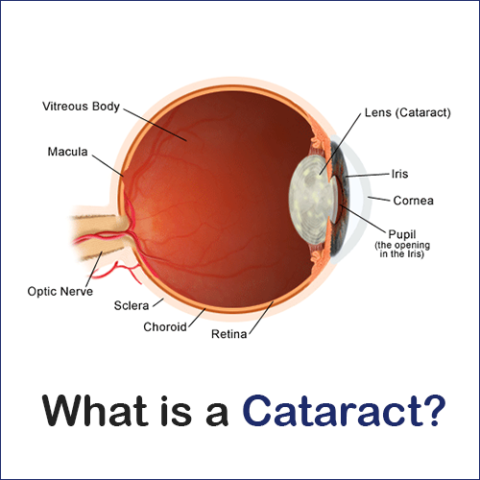
What is Cataract?
Having a cataract is a bit like having a dirty windscreen on a car. It can make the view cloudy or foggy. When the sun is behind you, the vision through the dirty windscreen is ok, but when you turn into the sun, the view through the windscreen becomes a white out. A cataract is similar in that glare from lights or the sun when it is low in the sky and on-coming headlights can all cause problems with the vision. When these problems make normal daily activities difficult, it is time to get the cataract operated on.
Cataracts do not permanently impair your vision and you will not go blind from a cataract. A simple operation will restore your sight. Most forms of cataract develop in adult life, and can occur any time after the age of 40. The normal process of ageing causes the lens to harden and become cloudy. Cataracts can also be caused by injuries to the eye, for instance, any cuts, blows or burns to the eye that cause damage to the lens inside the eye.
Inside the eye, behind the iris(the colored part of the eye) is a lens. In the normal eye, the lens is clear or transparent, and helps to focus light rays on to the tissue at the retina at the back of the eye. When a cataract develops, the lens becomes cloudy and prevents the light rays passing into the retina. The picture that the retina receives becomes dull and fuzzy. Cataracts usually form slowly and people experience a gradual blurring of vision.
Diagnosis
At the clinic, Eye Specialist will check your vision and will take a medical history to find out about your symptoms and what other medical problems you may or may not have. The doctor will then usually put some dilating drops in your eyes to make the pupils larger. This enables the eye doctor(ophthalmologist) to have a look at the cataract and also to look at the retina and the optic nerve and make sure that the cataract and not another problem cause the visual problems.
The effect of these drops will wear off after a few hours, however, your near vision will be blurred initially. For this reason you should not drive to appointments and you must be careful that you do not miss your footing, for instance walking down steps.
Once you have been diagnosed and your cataract progresses to the point that it is interfering with daily activities and normal lifestyle, you will be given an appointment for an operation to remove the cataract. Surgery is the only effective way of removing the cloudy lens. It cannot, for instance, be removed by laser, change in diet, or pills. In some parts of the world it is possible to buy pills to help prevent cataracts, but there is no proof that these work.
Pre-Surgery
If the ophthalmologist thinks your cataract should be removed, you will be advised accordingly. As of today, surgery is the only treatment for cataracts causing significant visual symptoms. You will be given an appointment shortly before your operation, when a nurse in the out patients department will carry out special tests to measure your eye. One of these is a test called Biometry which helps decide the strength of lens that will replace the cloudy lens in your eye. The nurse will organise any tests for your general health, to make sure you are healthy enough for surgery, such as blood tests and electrocardiograph(ECG).
If you have cataract developing in both eyes, you will not have treatment to both eyes at the same time. It is common for cataract to develop more quickly in one eye than the other, and usually, the more seriously affected eye is operated on first, although the ophthalmologist decides the timing of an operation.
Surgery
Usually you will be given anesthetics drops or injection outside the eye to make them numb, and you will be awake throughout the operation. Over 90% of all cataract surgery performed now is done under local anesthetics.
The operation usually takes about half an hour. Your surgeon will remove the cloudy lens by making a tiny opening into the eye at the edge of the cornea with the help of a machine called as Phacoemulsifier. Through this, he will remove the cloudy lens and insert a clear plastic implant lens, which will allow you to see again. The surgeon will use a microscope to perform the procedure.
In 90% of operations done today there is no need to take any stitches. The reason being that in Phacoemulsification method of cataract surgery the wound is of a very small size(2.5 to 2.8mm only) and this wound closes on its own.
Most operations for cataract are performed on a day care basis. This means that you are admitted to hospital, have your operation and are discharged home all in the same day. You do not stay overnight in hospital. For a minority of patients an overnight stay is needed.
Post-Surgery
After surgery, your operated eye will be covered with a protective plastic eye shield, and you may also have an eye pad underneath. As the anesthetic wears off, there can sometimes be a dull ache in and around the operated eye. Ask your doctor for tablets for pain relief.
For day care patients the eye shield(and pad if applied) is removed, the eye lids cleaned and eye examined just before your return home. If another pad is put on for the first night at home, you will be asked to remove it yourself the next day and the start to put in your eye drops. All patients are advised to wear the protective plastic eye shield when in bed at night for a month after the operation.
In preparation for your return home, the nursing staff will show you how to look after your eye, including how to clean your eyelids and put eye drops properly. Family, friends or colleagues can also be taught how to do this so that they can help you. The eye drops are necessary because the treatment prevents infection and helps reduce inflammation after surgery. You will not need to carry on with the drops for more than about two months, however, please follow the instructions your nurse or doctor give you.
Post-Surgery eyecare
You should avoid rubbing or touching your eye. You may find that you are sensitive to light, so it is useful to have a pair of plain dark glasses in case you need them.
Patients used to be told not to bend or lift heavy objects for a month, but with todays techniques this advice need only be taken for a week. After a week all normal activities including work can be resumed. That includes all activities.
The eye takes a few weeks to settle and for vision to return to normal. You will be advised about tests for spectacles to improve your vision at your next clinic appointment after the operation.
Cataract in children
Babies can be born with cataracts, called Congenital Cataracts. If a child is born with a cataract, surgery is usually performed as soon as possible to remove it and allow the childs sight to develop naturally.
If the cataract is not removed, eyesight will not develop as the brain does not learn to see pictures properly.
Glaucoma can follow cataract surgery in children, particularly when the cataract surgery has been done very early in life. The reason for the development of glaucoma after cataract surgery is still not entirely clear. It may be that very small proteins which are released during cataract surgery block up the flow of the filter system. If the eye becomes inflamed for any reason, such as in patients who have the childhood form of arthritis, the drainage system may get blocked with inflammatory cells. As a result, the pressure rises in the eye.
FAQs on Cataract
No. But often they develop in both eyes at the same time.
No. Cataract is not caused by overuse of the eyes and using the eyes when cataract starts to develop will not make the cataract worse.
Some people may or may not be aware that cataract is developing. It can start at the edge of the lens and initially may not cause problems with vision. Generally, as cataract develops, people experience blurring or hazing of vision. Often they become more sensitive to light and glare.
There may be a need to get new prescriptions for glasses more often when a cataract is developing. When the cataract worsens, however, stronger glasses no longer improve sight. Objects have to be held close to the eye to be seen. The hole in the iris(pupil) may no longer look black, a white or yellow appearance may be seen. The lens behind the pupil becomes more dense and cloudy(opaque) as the cataract develops.
There is no known prevention for cataract. Modern surgery is highly successful for the majority of patients.
Serious complications are uncommon following cataract surgery, however, like all operations problems an occur occasionally. If any of the following develop you must contact the Eye Surgeon at the earliest.
- Infection or inflammation following cataract surgery is very uncommon but can be serious. If the eye should become red, sore or aching in the days following surgery, you must contact the eye doctor
- An accumulation of fluid in the retina(Cystoid Macular Edema) can occur, causing blurring of the central vision. This usually resolves itself within a couple of weeks using drops.
- The implanted lens may occasionally move from its original position causing distorted vision. If this happens, further surgery may be needed to reposition the displaced lens.
- The retina may become separate from the inner wall of the eye. This is referred to as a retinal detachment and may require surgery. If you notice sudden shadows in your field of vision, floaters or flashing lights, contact the doctor immediately.
- Thickening of the membrane behind the new lens can occur in the months following surgery. This is referred to as capsular opacity. In this case, although the vision becomes blurred it can be treated with laser.
- In the event that stitches have been used, which is now rare, there is a very small risk of the thread breaking which makes the eye red and sore.
If you have any concerns following the operation, please see the nearest eye surgeon at the earliest.
Cataracts are treated using a high frequency ultrasound machine. This is the most modern and effective way to treat cataracts. Although lasers are used in many aspects of eye surgery, they are not used in cataract surgery. There are some lasers that are being developed to treat cataracts but at present they are not as effective as the ultrasound technique.