
What is Glaucoma?
Glaucoma is one of the worlds leading causes of blindess. Glaucoma is not curable, but blindness is preventable if the glaucoma is diagnosed and treated early enough. While there are usually no warning signs, regular eye tests will help detect the onset of the disease.
The term Glaucoma covers several different conditions like
- The most common is Chronic(primary open angle) Glaucoma - this form usually affects both eyes and develops slowly so that loss of sight is gradual. There is no pain, redness of the eye or dramatic change in vision.
- With Acute(angle closure) Glaucoma, there is a sudden increase in the pressure within one eye. The eye becomes red and painful. Often there is mistiness of vision and episodes of seeing haloes around lights.
- Sometimes, other diseases of the eye cause a rise in the pressure within the eye - this group of conditions is called Secondary Glaucoma.
- Congenital Glaucoma(buphthalmos) is a condition where glaucoma is present from birth. An increase in the pressure within the eye causes it to enlarge.
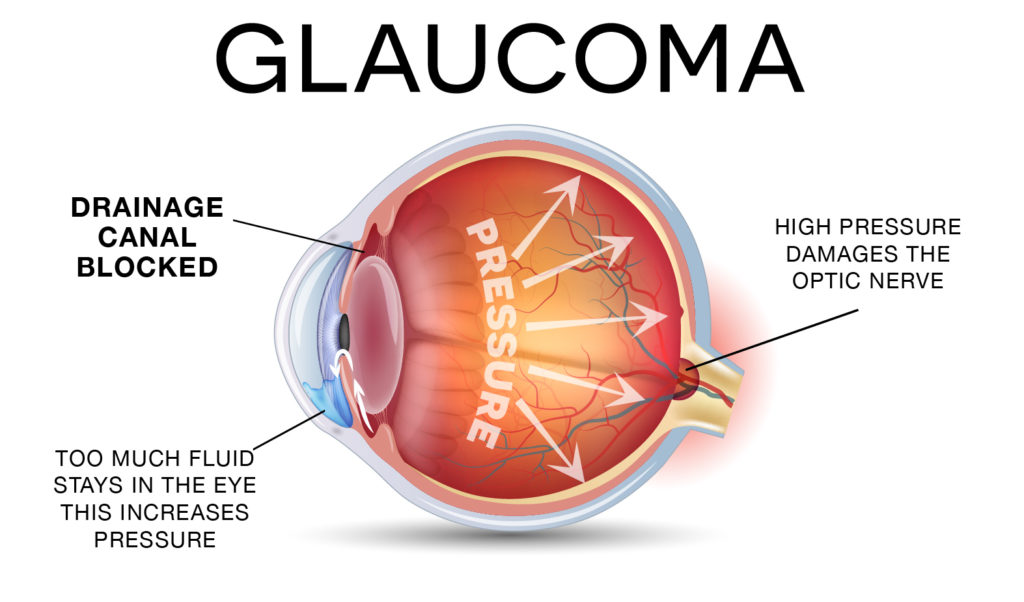
The contents of the eyeball are nourished by a fluid called Aqueous Humour, which is different to tears. It is secreted within the eye by a tissue called the Ciliary Body, and leaves the eye via another tissue, called the Trabecular Meshwork. This meshwork is situated at the back of the eye.
An increase in the pressure within the eye usually happens because there is an obstruction within the Trabecular Meshwork. The obstruction means that the aqueous within the eye is not drawn out, although it continues to be produced. There is a build up of fluid in the eye, which increases the pressure.
This increased pressure pushes on the back of the eye, which damages the optic nerve. The optic nerve carries signals to the brain from the eye, and when this is damaged, it causes irrepairablesight loss.
Glaucoma is an eye condition characterized by loss of vision due to damage of the optic nerve. The optic nerve carries sight images to the brain, and any damage to the nerve results in damage to sight.
Usually, but not always, the damage occurs because pressure within the eye increases and presses on the nerve, which damages it.
Diagnosis
When you come in to see your ophthalmologist, you are likely to undergo some simple, pain free tests. These tests will allow the doctor to make a diagnosis and help her decide what kind of treatment you will need. You are advised not to drive to clinic appointments, as some of the eye drops can temporarily blur your vision.
First, the pressure in your eye will need to be measured. An anesthetics drop will be given to numb the front of the eye. You will be asked to place your head in the slit lamp and the doctor or nurse will shine a blue light into your eye. The surface of the cornea(window of the eye) will then be touched lightly with an instrument, which measures the eye pressure.
You will also need one or more of the following tests:
- Gonioscopy - An anesthetic drop is given to numb the front of the eye. The ophthalmologist holds a special lens against the cornea. This gives them a better view of the inside of the eye for further examination.
- Visual Field test- The visual field is the range of sight we have on each side of an object we are looking at, and the extent of the visual field can be measured. The field test takes about 15 minutes per eye. You will be asked to sit at a screen and keep your gaze fixed on a central light source. You will need to indicate(by pressing a button) if you can see a series of other lights, no matter how dim, shown during the test. You are not expected to see all the lights. This test detects if there are any missing areas in your visual field caused by damage to the optic nerve.
- Optic nerve assessment - Drops will be put in your eyes to make your pupils bigger. The effect of these will wear off after a few hours but may temporarily blur your vision preventing you from reading or driving. The doctor will then look at the back of the eye through an ophthalmoscope(which looks like a small camera), to check the health of the optic nerve.
- Photographs - Color photos taken of the back of the eye will be taken and are kept in your file. These can be used to establish whether any changes occur later. Before photography, drops to make your pupils bigger(as above) are given.
Your doctor will examine the results of the tests, and will use these to help decide on the best method of treatment for you.
Treatment
Glaucoma can be treated but not cured. The aim of treatment is to lower the pressure within the eye and prevent further damage to the optic nerve and visual loss. Because treatment can only control, not cure, the condition, it must be continued throughout life.
Following types of treatment procedures are available to treat Glaucoma:
- Eye drops
- Tablets
- Surgery
- LASER Surgery
Eye drops
The first form of treatment is usually eye drops, a fluid form of medicine for the eye which lower the eye pressure. Putting drops in properly and as prescribed is essential to try to prevent any further sight loss.
Drops may sting when first used, and some of the eye drops do have other side effects. Sometimes these arise from the drops being absorbed too quickly into the blood stream. You can slow the absorption by pressing your forefinger of your free hand against the lower lid where it meets your nose; or close your eye for 60 seconds.
Pilocarpine drops make your pupil smaller and can temporarily cause brow ache each time the drops are used. In dim lighting your vision may appear worse. These effects usually wear off after 1 or 2 weeks.
If you notice breathlessness with any eye drops, stop the drops immediately and consult your General Practitioner. Please inform the clinic doctor if you have a heart or chest condition. Some drops are not suitable for asthmatics.
Tablets
Tablets of acetazolamide (Diamox®) may be given to patients. These reduce the amount of aqueous produced within the eye, taking the pressure off the back of the eye.
The tablets initially increase the amount of urine passed and as well as the amount of salts leaving the body. This can cause some patients to experience tingling in their hands/feet and or nausea and tiredness. If you notice any side effects tell your ophthalmologist.
Surgery
In some forms of Glaucoma an operation may be necessary. The most common operation is a Trabeculectomy, where a small piece of tissue is removed to make a new opening for the aqueous fluid to escape from the eye. The escaping fluid is absorbed into the tissues which form the outer coat of the eye.
Your doctor will discuss these and any other treatments you are prescribed. It is essential that you follow the course of treatment given to you as not doing so may result in further loss of sight.
LASER Surgery
Recently various lasers have been used to manage different types of glaucomas.
Nd:YAG laser is used in Angle Closure type of Glaucoma to make a hole in the Iris, thereby improving the circulation of Aqueous Humor(watery liquid in the front chamber of the eye). It is also used to make holes in the Trabecular Meshwork(draining channels in the angle between the cornea and iris), again to facilitate easy drainage of aqueous, in the Open Angle type of Glaucoma. The procedure is called Selective Laser Trabeculoplasty(SLT). Both the above procedures are practically painless and are done within a very short time.
Diode Lasers are used in a procedure called Laser Cycloablation, in cases of Glaucoma uncontrolled by other means, where there is no hope of gaining any form of vision.
FAQs on Glaucoma
No, but regular eye checks will enable early detection and treatment. Please insists on getting your eye pressure and optic nerve checked every time you have a eye examination.
laucoma is not catching, and is not caused by diet, work or other factors. Many people get Glaucoma as they get older, and it seems to be part of the natural ageing process. Some groups of people are known to be at more risk:
- Relatives of someone diagnosed with Glaucoma(particularly siblings)
- People of Chinese origin
- People with severe Myopia(short-sightedness)
- People with Diabetes and Uncontrolled high blood pressure.
If you have been diagnosed with Glaucoma, this does not mean you will go blind, especially if you have been diagnosed with Glaucoma at an early stage in the disease. Drops and sometimes operations can stabilize the Glaucoma, and with regular check-ups, you will be able to manage the condition. You will experience some degree of sight loss but it will be minimized with effective treatment.