
What is Dry Eye?
Dry Eye(also called dry eye syndrome) is a very common condition. Dry eye occurs when people do not have either enough tears, or the correct composition of tears, on the surface of their eyes to lubricate the eyes and keep them comfortable.
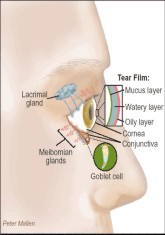
The diagram shows the tear film and its layers along with the location of the glands responsible for the secretion of the components of the film onto the surface of the eye. The outer, oily layer of the tear film is produced by the meibomian glands in the eyelids and reduces evaporation of the tears. The thick, middle, watery layer is made by the lacrimal gland above the upper eyelid and washes away irritants. The inner, mucus layer is secreted by the goblet cells in the conjunctiva of the eyelids and helps the tear film stick to the cornea.
The prevalence of Dry Eye increases with age, so that it is extremely common in older people of both sexes. The condition affects 2 – 3 times more women than men.
Symptoms
If you have dry eye, your eyes can feel persistently gritty, itchy, burning, and painful. These sensations often worsten as the day goes on. Stringy mucus may appear in or around the eyes. You will know if you have dry eye. The condition does not require sophisticated diagnosis. Patients with the most severe disease are at increased risk of developing corneal infection, scarring or ulceration. These conditions can cause permanent vision loss, so it is important to seek professional help if you have severe symptoms of dry eye.
Dry eye syndrome is not a frequent cause of blindness; however, it is still an important public health problem. One reason for this is that it is so common. In fact, visits for dry eye syndrome are one of the leading reasons for patients to seek eye care. This is because its symptoms are very bothersome and lead to a decreased quality of life, reduced work capacity, and poor psychological health. Furthermore, dry eye syndrome is associated with a decreased ability to perform activities that require visual attention, such as reading and driving a car.
Severe dry eye is sometimes caused by Sjögren’s syndrome, which is a chronic, multi-organ, autoimmune disorder that also results in dry mouth and often arthritis.You should be under a doctor’s frequent care if you have Sjögren’s.
Diagnosis
Some very simple tests are used to diagnose dry eye. Schirmmer test is one of them. Here a filter paper strip of a particular length is kept In the lower lid space and its wetting is measured.  Staining of the Cornea and Conjunctiva with special dye like Fluoroscein and Rose Bengal are some of the other ways to diagnose dry eye.
Computer Vision Syndrome
People who work on computers or any kind of video display unit for very long hours, tend to develop symptoms of dry eye.
Some simple measures can help in relieving these symptoms, like working at a comfortable distance from the monitor, blinking frequently(average of 20 times in a minute), no staring at the monitor, keeping the brightness and contrast levels of the monitor to a comfortable level, taking intermittent rest during working hours, no sitting in front of an air draft ( a/c., fan), keeping the monitor at a slightly lower level than the eye, keeping yourself well hydrated, maintaining a comfortable posture.
Prevention is better than cure
Anything that may cause dryness, such as an overly warm room, hair dryers, smoke or wind should be avoided by any person with dry eye. A humidifier in heated rooms may help. If wearing contact lenses increases your discomfort, wear spectacle eye-glasses instead. Some people with dry eye complain of scratchy eyes when they wake up. This symptom can be treated by using an artificial tear ointment at bedtime. There is some evidence that, in older women, hormone replacement therapy makes dry eye worse. If you are using HRT, talk to your doctor about this. And seek help if symptoms occur frequently or interfere with your functioning; it is important to see an ophthalmolist or optometrist to rule out corneal injury or infection.
Treatment
The first line of treatment is usually eye drops that act as artificial tears and give some temporary relief. These solutions and ointments give some temporary relief, but do little to arrest or reverse any damaging conditions. Many brands are available without a prescription. For mild cases, try several to find the one you like best. The preservatives in some eye drops can irritate the eye. Preservative-free artificial tears may be required. Researchers are trying to develop better artificial tears, especially ones that are formulated to normalize the electrolyte balance while lubricating the ocular surface. One promising new treatment now in clinical trials is the use of eye drops containing andogen.
For more severe cases of dry eye, in which the cornea is inflamed, anti-inflammatory agents are sometimes prescribed. Topical steroids(in eye drops) are safe for short-term use, to combat inflammation, but can cause side-effects when used for a long time. A current research area is how to actively suppress inflammatory mechanisms, rather than just passively lubricate the surface of the eye. Tears drain out of each eye, and into the nose, through a small channel. Your ophthalmologist may decide to close these channels either temporarily or permanently, to keep the tear film on the surface for a longer time. For some forms of dry eye, tiny plugs can keep tears on the eye surface by slowing the rate of drainage from the eye; this procedure is called Punctal Occlusion.